
AI Agents vs Chatbots vs LLMs: What Your Business Really Needs
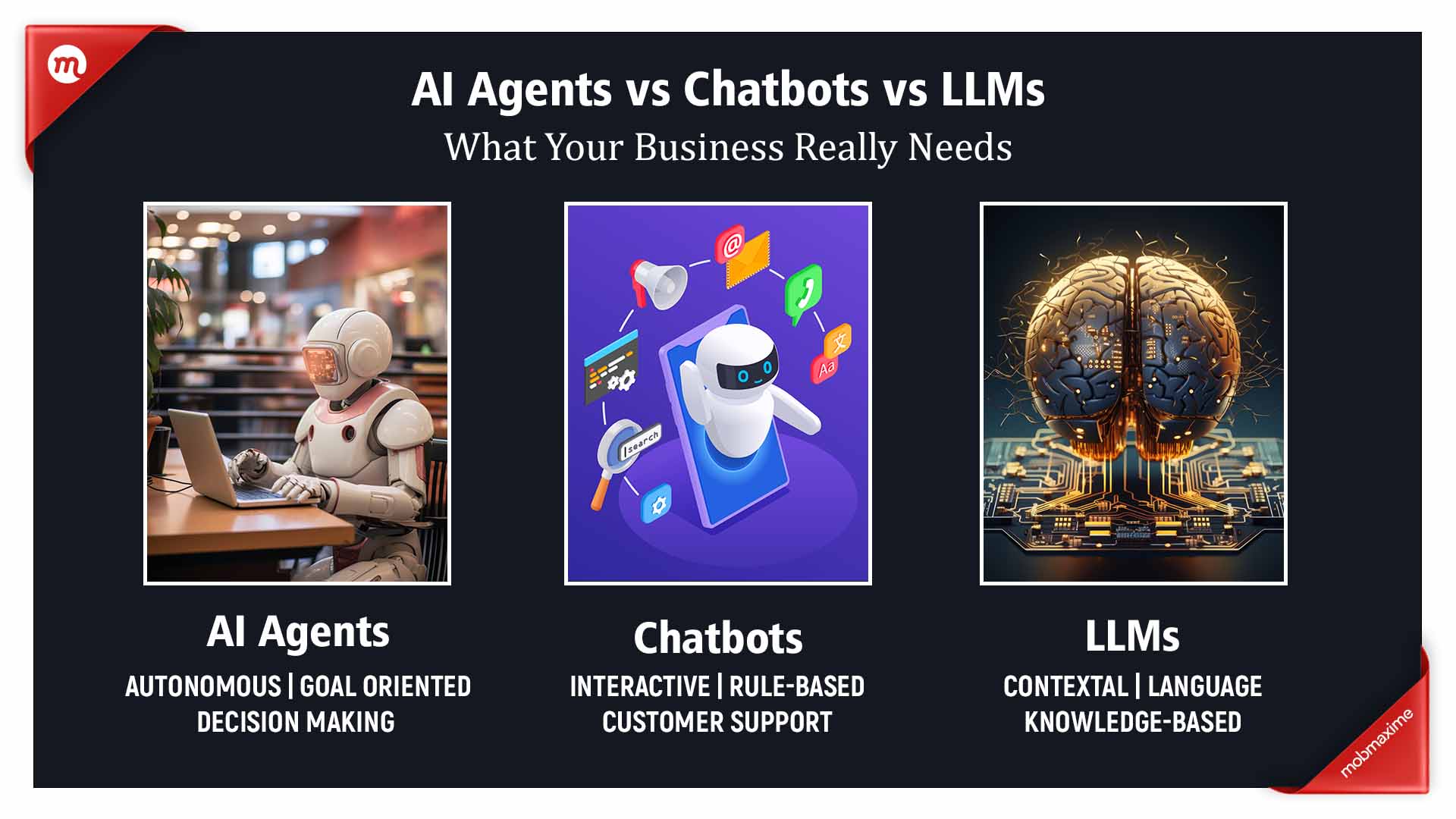
Artificial intelligence is no longer a future investment—it is a present-day business necessity. In 2026, companies are actively choosing between AI agents, chatbots, and large language models (LLMs) to automate operations, improve customer experience, and drive revenue. However, selecting the wrong AI approach can lead to wasted budgets, poor ROI, and operational risk.
This guide provides a clear ai agents vs chatbots vs llms comparison, helping business leaders understand how to choose AI for business, what solution fits their goals, and how to future-proof their AI strategy.
Must Read: Generative AI vs Agentic AI vs Autonomous AI: Understanding the Key Differences
Why the AI Decision Matters More in 2026
AI adoption has matured. Businesses no longer ask “Should we use AI?” but “Which AI solution will actually solve our problems?”
In 2026, AI systems are:
-
More autonomous
-
More integrated with business tools
-
More regulated
-
More expensive to scale incorrectly
Choosing the best AI solution for business automation depends on understanding what each technology can—and cannot—do.
Understanding the Core Difference: AI Agents vs Chatbots vs LLMs
Before implementation, businesses must understand the fundamental differences between them.

Chatbots: Task-Specific Conversational Tools
Chatbots are rule-based or AI-assisted systems designed to handle predefined conversations. They are commonly used for:
-
Customer support FAQs
-
Lead qualification
-
Appointment booking
Strengths
-
Fast deployment
-
Low cost
-
Predictable behavior
Limitations
-
Cannot reason independently
-
Limited automation capabilities
-
Break outside predefined flows
Chatbots are best for simple, repetitive interactions, not complex decision-making.
LLMs (Large Language Models): Intelligence Without Autonomy
LLMs such as GPT-style models are powerful engines capable of understanding and generating human-like language. Businesses use them for:
-
Content generation
-
Knowledge assistance
-
Data interpretation
Strengths
-
High-quality language understanding
-
Flexible responses
-
Multi-domain knowledge
Limitations
-
No built-in execution ability
-
Cannot act without external logic
-
Require orchestration to be useful
LLMs are brains without hands—they think but do not act on their own.
AI Agents: Autonomous Systems That Execute Work
AI agents represent the next generation of business AI. They combine:
-
LLM intelligence
-
Tool access (CRM, APIs, databases)
-
Memory
-
Decision logic
AI agents can:
-
Analyze data
-
Decide next steps
-
Execute actions
-
Learn from outcomes
This is why next-generation AI agents for business are rapidly replacing traditional automation.
AI Agents vs LLMs vs Chatbots Comparison (Business Perspective)
| Feature | Chatbots | LLMs | AI Agents |
|---|---|---|---|
| Conversational ability | Basic | Advanced | Advanced |
| Autonomous decision-making | ❌ | ❌ | ✅ |
| Task execution | ❌ | ❌ | ✅ |
| Workflow automation | Limited | No | Full |
| Business scalability | Low | Medium | High |
| Long-term ROI | Low | Medium | High |
How to Choose AI for Business in 2026
Choosing AI is not about trends—it is about business readiness and objectives.
Choose Chatbots If:
-
You need basic customer interaction
-
Your workflows are static
-
Budget is limited
Choose LLMs If:
-
You need intelligence, not automation
-
Your team can manually act on AI outputs
-
Content or knowledge support is the goal
Choose AI Agents If:
-
You want end-to-end automation
-
You need AI to make decisions and act
-
You are scaling operations or revenue
For most growing organizations, AI agents offer the best AI solution for business automation in 2026.
Custom AI Agent Development for Business: When Off-the-Shelf Is Not Enough
Prebuilt AI tools are useful, but they fail when businesses need:
-
Custom workflows
-
Secure internal data handling
-
Deep system integrations
-
Compliance with regulations
Custom AI agent development for business allows organizations to:
-
Design agents around their processes
-
Integrate CRM, ERP, marketing, and sales tools
-
Control data, logic, and security
-
Achieve sustainable competitive advantage
Custom development is no longer a luxury—it is becoming a strategic requirement.
AI Agents Cost for Business: What to Expect
Understanding AI agents cost for business is critical for planning.
Cost Depends On:
-
Number of workflows automated
-
Data sources and integrations
-
Model usage and infrastructure
-
Compliance and security requirements
Typical Ranges (2026)
-
Basic AI agent: $15,000–$30,000
-
Mid-level business agent: $40,000–$80,000
-
Enterprise-grade AI agent systems: $100,000+
While the upfront cost is higher than chatbots, AI agents deliver higher ROI through automation, efficiency, and scalability.
Enterprise AI Implementation Strategy
An effective enterprise AI implementation strategy focuses on long-term value, not short-term experimentation.
Key Principles:
-
Start with high-impact workflows
-
Integrate AI with existing systems
-
Maintain human-in-the-loop control
-
Monitor performance and bias
-
Scale gradually with governance
Enterprises that treat AI agents as core infrastructure, not tools, gain sustained advantage.
Future of Business AI Automation
The future of business AI automation is autonomous, adaptive, and agent-driven.
By 2026 and beyond:
-
AI agents will coordinate across departments
-
Multi-agent systems will handle complex operations
-
Manual process management will decline
-
Businesses without AI agents will fall behind
This shift explains why next generation AI agents for business are central to digital transformation strategies worldwide.
Common Mistakes Businesses Make When Choosing AI
-
Buying chatbots expecting automation
-
Using LLMs without execution layers
-
Ignoring long-term scalability
-
Underestimating integration complexity
-
Failing to plan governance and compliance
Avoiding these mistakes starts with understanding the ai agents vs chatbots vs llms distinction clearly.
Final Thoughts: What Your Business Really Needs in 2026
AI success is not about adopting the most advanced technology—it is about choosing the right AI architecture for your business goals.
-
Chatbots handle conversations
-
LLMs provide intelligence
-
AI agents deliver automation and outcomes
For most businesses in 2026, AI agents represent the most complete, future-proof solution—especially when built and implemented strategically.
Frequently Asked Questions (FAQs)
1. What is the main difference between AI agents, chatbots, and LLMs?
The main difference is capability. Chatbots handle predefined conversations, LLMs generate intelligent responses, while AI agents can autonomously make decisions and execute tasks across business systems.
2. Are AI agents better than chatbots for business automation?
Yes. AI agents are better for business automation because they can connect with tools, trigger workflows, and complete tasks independently, whereas chatbots are limited to conversation-based interactions.
3. When should a business choose LLMs instead of AI agents?
A business should choose LLMs when it needs language intelligence such as content creation, insights, or knowledge assistance, but does not require autonomous execution or workflow automation.
4. How much does it cost to implement AI agents for a business?
AI agent implementation costs vary based on complexity, integrations, and scale. In 2026, basic AI agents may start around $15,000, while enterprise-grade systems can exceed $100,000 depending on requirements.
5. Can AI agents replace human employees?
AI agents do not replace employees but augment them. They automate repetitive tasks, assist with decision-making, and allow human teams to focus on strategic, creative, and high-value work.
6. How do businesses start implementing AI agents successfully?
Successful implementation starts with identifying high-impact workflows, choosing the right AI architecture, integrating securely with existing systems, and scaling gradually with proper governance and monitoring.

Join 10,000 subscribers!
Join Our subscriber’s list and trends, especially on mobile apps development.I hereby agree to receive newsletters from Mobmaxime and acknowledge company's Privacy Policy.