
AI for Customer Success Teams: Use Cases, Tools & Best Practices
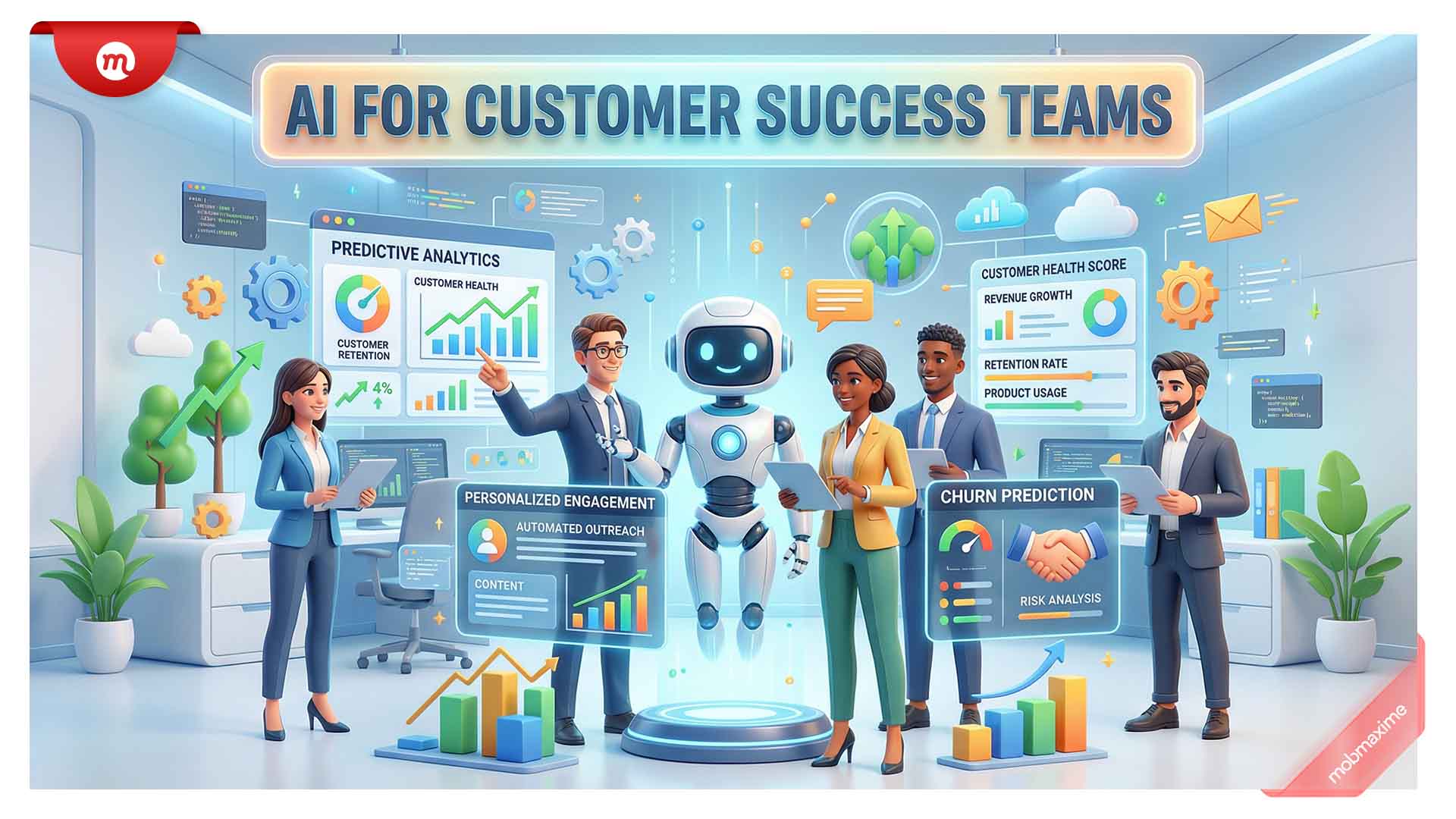
Why Customer Success Teams Are Turning to AI
Customer success used to be simple — or at least it felt that way. A team of dedicated managers, a shared spreadsheet of accounts, regular check-in calls, and a renewal tracker that turned red when things went sideways. That worked when you had 50 customers. It breaks the moment you have 5,000.
Today, customer success teams are under pressure from every direction. More accounts to manage. Higher expectations for personalization. Tighter renewal cycles. And leadership asking for metrics that prove CS actually drives revenue — not just goodwill. That’s exactly where AI steps in — not to replace your team, but to give every CS manager the analytical horsepower of a data scientist and the memory of an elephant.
| 89%
of businesses compete primarily on customer experience (Gartner) |
5–7×
more expensive to acquire a new customer than retain one |
| 60%
faster churn identification with AI-powered health scoring |
3×
more accounts managed per CSM with AI automation support |
According to Gartner, by 2026, more than 75% of B2B sales and customer success interactions will be AI-augmented. The question isn’t whether to adopt AI in your customer success operations — it’s how fast you can do it without disrupting what’s already working.
What AI in Customer Success Actually Means
Let’s be direct — the phrase ‘AI for customer success’ gets thrown around a lot. Some vendors use it to mean a basic chatbot. Others use it to describe a full predictive analytics platform. Before you can pick the right tools or build the right strategy, you need to understand what AI in this context actually does.
At its core, AI for customer success refers to the application of machine learning, natural language processing (NLP), predictive analytics, and automation to help CS teams understand customer behavior, anticipate problems, and take action at scale.
Think of it this way: AI doesn’t replace your customer success manager. It gives them a superpower — the ability to instantly know which of their 200 accounts is at risk of churning, what’s driving that risk, and what the best next action is to fix it.
The three pillars of AI in customer success are:
- Predictive Intelligence — Using historical data to forecast churn, expansion opportunities, and engagement trends before they happen
- Workflow Automation — Removing repetitive tasks like QBR prep, health score updates, follow-up emails, and onboarding triggers
- Conversational AI — Smart assistants and AI-powered communications that respond to customers at the right moment with the right message
If your team is spending more time updating CRMs than actually talking to customers, AI isn’t a luxury — it’s a necessity. Our AI application development services are specifically designed to help businesses build intelligent systems like these from the ground up.
Top AI Use Cases for Customer Success Teams
Here are the highest-impact ways CS teams are using AI right now — not in theory, but in live production environments across SaaS, fintech, healthcare, and enterprise software companies.
-
Predictive Churn Scoring
AI models analyze product usage, login frequency, support ticket volume, and payment history to assign real-time risk scores to every account — so your team acts before a customer even thinks about leaving.
-
Automated Health Scoring
Replace static, manually-updated health scores with dynamic AI-driven scores that update continuously based on dozens of behavioral signals, not just NPS surveys.
-
Personalized Outreach at Scale
AI drafts personalized check-in emails, renewal nudges, and upsell recommendations based on each customer’s usage pattern and business context — so every message feels written just for them.
-
Call Intelligence & Sentiment Analysis
NLP-powered tools transcribe and analyze customer calls in real time, detecting frustration, confusion, or buying signals — and automatically logging insights into your CRM.
-
Intelligent Onboarding Automation
AI identifies where new customers are getting stuck during onboarding and triggers the right support content, tutorial, or human touchpoint at the right moment.
-
Expansion & Upsell Detection
Machine learning models identify accounts exhibiting patterns consistent with high-value customers before they’ve asked to upgrade — turning CS into a revenue driver, not just a retention function.
-
AI Chatbots for Self-Service
Intelligent chatbots handle tier-1 support queries 24/7, escalate complex issues to humans, and reduce ticket volume while maintaining a high-quality customer experience.
-
QBR and Reporting Automation
AI pulls, organizes, and formats quarterly business review data automatically — turning a half-day preparation task into a 15-minute review process for your CSMs.
Companies using AI-powered churn prediction report up to a 30% reduction in customer churn within the first year of adoption. If you’re curious how AI agents differ from chatbots and LLMs, understanding those distinctions will help you select the right technology for each of these use cases.
Best AI Tools for Customer Success Managers
The market for AI-powered customer success platforms has matured significantly. Here’s an honest breakdown of the most capable tools available right now.
| Tool | Primary AI Capability | Best For | Pricing |
| Gainsight | Predictive churn, health scoring, workflow automation | Enterprise SaaS teams | Custom (enterprise) |
| Totango | Customer journey orchestration, segment-based AI | Mid-market B2B | From $1,490/mo |
| ChurnZero | Real-time usage alerts, AI-driven playbooks | Subscription businesses | Custom pricing |
| Intercom (Fin AI) | GPT-powered customer support resolution | Support & onboarding automation | From $39/seat/mo |
| Salesforce Einstein | CRM-embedded AI, predictive scoring | Salesforce-native teams | Add-on to SF license |
| Gong.io | Conversation intelligence, deal risk AI | CS teams with high call volume | Custom pricing |
| Mixpanel + AI | Behavioral analytics, cohort prediction | Product-led growth companies | Free to $833/mo |
| HubSpot AI | Content AI, predictive lead scoring, email automation | SMB customer success teams | From $45/mo |
If your organization has unique data, workflows, or compliance requirements, an off-the-shelf tool may not be enough. Custom AI software development allows you to build a solution tailored precisely to your customer success operations, tech stack, and industry requirements.
How to Use AI in Customer Success: Step-by-Step
Knowing the tools and use cases is the starting point. Actually implementing AI in your CS team is where most organizations stumble. Here’s a framework that works — borrowed from real deployments, not a consulting deck.
- Audit Your Current Customer Data
AI is only as good as the data you feed it. Inventory your data sources — CRM records, product usage analytics, support ticket history, billing data, NPS responses. Clean, structured data is the foundation everything else is built on.
- Define Your Biggest CS Pain Point First
Don’t try to AI-ify everything at once. Pick the single most painful problem — usually churn prediction or onboarding drop-off — and build your first AI use case around that. Quick wins build internal credibility and team buy-in.
- Select Your AI Platform or Build Custom
Match your use case to the right tool. If you have highly specific workflows or proprietary data, consider a custom AI development partner who can build around your existing architecture.
- Integrate with Your Existing Stack
Your AI tools need to talk to your CRM, your product analytics platform, and your communication tools. This is where many deployments fail — poor API integration creates data silos instead of eliminating them.
- Train Your CS Team on AI Outputs
A churn risk score means nothing if your CSMs don’t know how to act on it. Build playbooks around AI triggers. Train your team to interpret model outputs, not just read numbers.
- Measure, Iterate, and Expand
Track the metrics that matter: churn rate, NRR, time-to-value for new customers, and CSM account capacity. Use those numbers to justify expanding AI adoption to new use cases and account segments.
For a broader view of how automation is changing how software companies operate, our blog on automation in software development is a useful companion read to this guide.
Best Practices for AI-Powered Customer Success
Getting sustained results from AI in CS requires operating discipline. These are the practices that separate teams who see 40% churn reduction from those who have an expensive tool collecting dust.
- Keep the Human in the Loop
AI should flag risk and recommend actions — but a human CSM should make the final call on how to engage a strategic account. Customers in crisis don’t want an automated message. They want a person who understands their business. Use AI to prioritize who your team talks to, not to replace those conversations.
- Set a Feedback Loop for Model Accuracy
Your churn prediction model will drift over time as customer behavior changes. Build a formal review cadence — quarterly at minimum — where you evaluate model accuracy, flag false positives, and retrain with updated data.
- Align CS and Product Teams Around AI Signals
When AI identifies a usage drop or onboarding friction point, that’s valuable signal for your product team too. Break down the silos between CS and product so that customer behavior data flows in both directions.
- Segment Your AI Strategy by Customer Tier
High-touch enterprise accounts need AI to inform and support human relationships — not replace them. Tech-touch SMB accounts can be managed almost entirely through AI-driven automation. One-size-fits-all AI strategies fail because enterprise and SMB customers have fundamentally different expectations.
- Don’t Over-Automate Customer-Facing Communications
AI-generated emails that feel robotic will hurt your retention, not help it. Use AI to draft and personalize communications, but build in a human review layer for anything going to high-value accounts. Customers can tell the difference — and it matters to them.
Pro Tip from MobMaxime’s AI Team: The companies getting the most ROI from AI in customer success are not the ones with the most sophisticated models. They’re the ones who’ve done the unglamorous work of cleaning their data, aligning their team, and building tight feedback loops between AI outputs and human actions.
Common Challenges and How to Overcome Them
-
Challenge 1: Dirty or Incomplete Data
AI models trained on inconsistent CRM data produce unreliable predictions. Fix your data hygiene issues before you deploy any AI tool. This often means a 4–8 week data audit and cleanup project — unglamorous but essential.
-
Challenge 2: Team Resistance to AI
CSMs who’ve built their value on relationship intuition may feel threatened by AI health scores that suggest they’re wrong about an account. Address this early — frame AI as an assistant that makes them look smarter, not a system that questions their judgment.
-
Challenge 3: Integration Complexity
Most CS teams use 5–8 different tools. Getting AI to work across all of them requires robust API work and sometimes a custom integration layer. Working with an experienced web and software development partner can save months of frustration.
-
Challenge 4: Measuring AI ROI
Measure AI success by business outcomes: net revenue retention, churn rate, time-to-value, and CSM capacity (accounts managed per person). These are the numbers your CFO cares about, and they’re what justify continued AI investment.
Understanding the difference between generative AI, agentic AI, and autonomous AI is also important when planning which type of AI is right for your specific customer success workflows.
Conclusion
AI isn’t coming for customer success teams — it’s already here.
The teams embracing it are pulling away from those still managing accounts in spreadsheets. But the winning playbook isn’t about adopting the most AI tools or replacing your CSMs with automation. It’s about using AI to make your team smarter, faster, and more proactive — so they can focus their human energy where it matters most: building genuine relationships that drive long-term growth.
The CS leaders who will win in 2026 and beyond are those who treat AI as a strategic multiplier, not a cost-cutting shortcut. Start with your most painful problem. Get your data right. Build the feedback loops. And never forget that at the end of every account number is a human who just wants to be successful with your product.
MobMaxime has helped businesses across industries build custom AI systems that power customer success, retention, and growth. If you’re ready to take a step beyond off-the-shelf tools, let’s start a conversation.
Ready to Transform Your Customer Success with AI?
MobMaxime builds custom AI-powered platforms that help customer success teams predict churn, automate workflows, and scale relationships — without losing the human touch.
Get a Free AI Strategy Consultation
No commitment. Just a genuine conversation about what AI can do for your CS team.
Frequently Asked Questions (FAQ)
Q – 1: What is AI for customer success?
Answer: AI for customer success refers to using machine learning, predictive analytics, NLP, and automation to help CS teams monitor customer health, predict churn, automate repetitive tasks, and personalize outreach at scale. It gives CS managers data-driven insights that would be impossible to generate manually across large account portfolios.
Q – 2: How is an AI customer success platform different from a standard CRM?
Answer: A CRM stores and organizes customer data. An AI customer success platform actively analyzes that data to generate predictions, automate workflows, and recommend next best actions. Think of a CRM as a database and an AI CS platform as the intelligence layer on top — one tells you what happened, the other tells you what’s about to happen and what to do about it.
Q – 3: How much does it cost to implement AI in a customer success team?
Answer: SaaS platforms like Gainsight and ChurnZero start at a few thousand dollars per month for mid-market teams. Enterprise deployments can run $50,000–$200,000+ annually. Custom AI development for organizations with unique requirements typically ranges from $30,000 to $150,000 depending on scope, data complexity, and integration requirements.
Q – 4: How do I get started with AI tools for my customer success team?
Answer: Start by auditing your existing customer data quality — AI is useless without clean inputs. Then identify your single biggest CS challenge and find a tool that solves that specific problem. Avoid trying to deploy AI across all functions simultaneously. A focused, phased approach consistently outperforms big-bang AI rollouts.
Q – 5: Can AI replace customer success managers?
Answer: No — and organizations that try to use it that way typically see a drop in retention. AI handles analytical and repetitive tasks; human CSMs handle judgment, relationship depth, and complex problem-solving. The right model is AI augmenting human capacity, not replacing it. Teams using AI as an assistant consistently outperform both fully automated and fully manual approaches.
Q – 6: What data does AI need to predict customer churn accurately?
Answer: The most predictive churn signals are product usage frequency and depth, support ticket volume and sentiment, login recency, billing history and payment friction, NPS scores, and time-since-last-engagement. Historical data going back 12–24 months produces the most reliable predictions.
Q – 7: Should I build a custom AI solution or use an off-the-shelf CS platform?
Answer: Use an off-the-shelf platform if you have standard workflows, clean data, and a common tech stack. Consider custom AI development if you have unique business processes, industry-specific compliance requirements, proprietary data structures, or need deep integration with legacy systems.
Q – 8: What’s the biggest mistake CS teams make when adopting AI?
Answer: Deploying AI before fixing their data. Predictive models trained on incomplete, inconsistent CRM data produce unreliable outputs — which erodes team trust and leads to abandonment of the tool. The second most common mistake is not building playbooks around AI outputs, so CSMs see a risk score but don’t know what action to take. AI without process is just noise.

Join 10,000 subscribers!
Join Our subscriber’s list and trends, especially on mobile apps development.I hereby agree to receive newsletters from Mobmaxime and acknowledge company's Privacy Policy.