
MERN vs MEAN vs T3 Stack: Best Full-Stack Combo in 2026
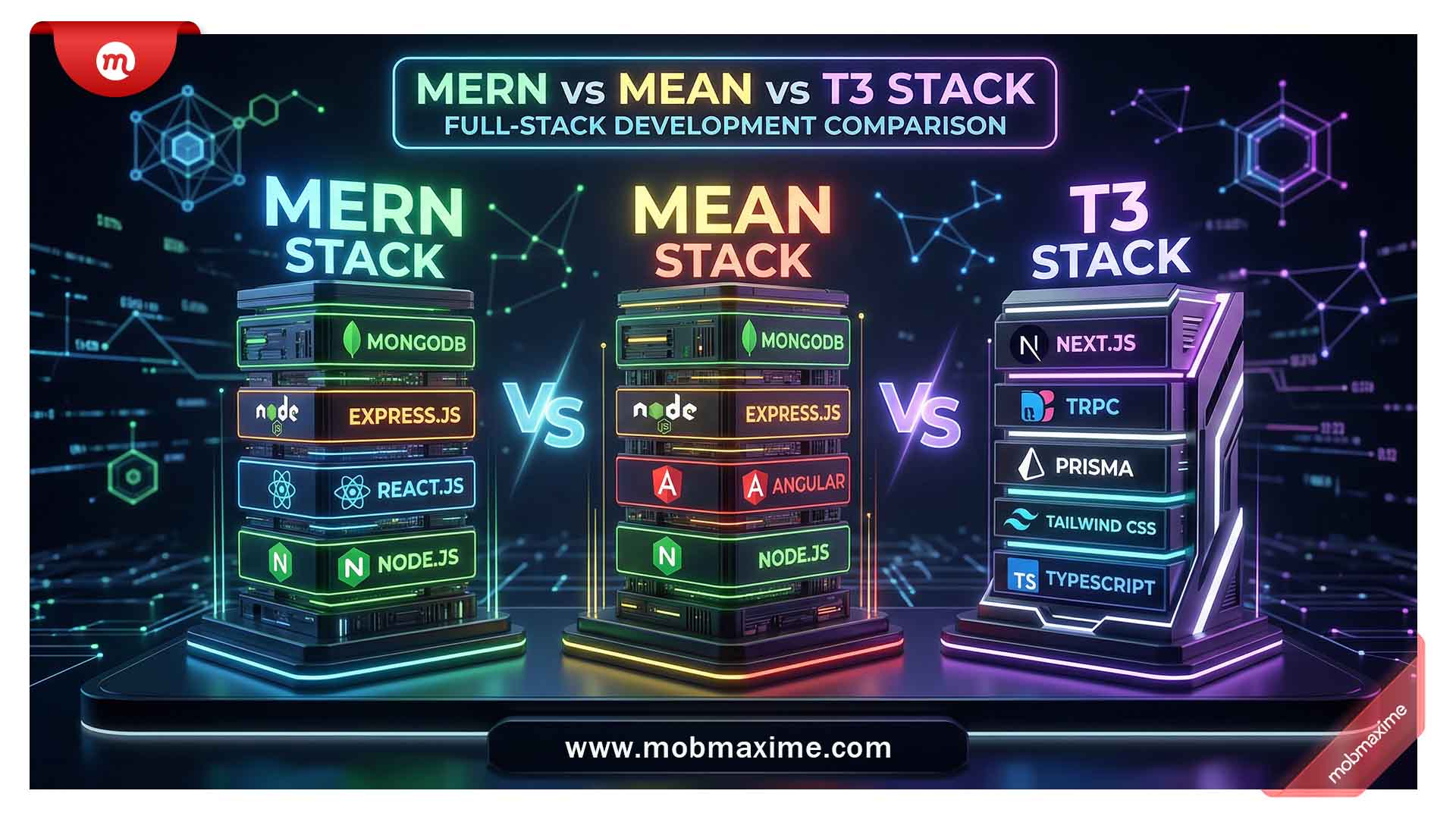
The difference between MERN vs MEAN vs T3 arises from the tools, frameworks, and databases used in each to build apps and websites.
MERN has unidirectional data flow, MERN has an opinionated structure with bidirectional data binding, and the T3 Stack renders server-side and Prisma ORM over traditional NoSQL.
Confusing, right?
Well, let’s decode what all these mean and get to the bottom of these discussions. Read on if you want to choose the best full-stack for startups and SaaS platforms.
Must Read: Full-Stack vs. MEAN Stack vs. MERN Stack: How to Choose the Right Stack?
Why is Choosing the Right Full Stack Important in 2026?
Any website or application today is expected to do the following:
- Real-time interactions.
- Integrate AI-driven services.
- Handle large volumes of data.
- Deliver seamless user experiences.
And the list goes on…
The same products are expected to perform seamlessly on all devices and platforms. As we experience this shift in preferences and expectations, the usage of the right stack has become even more critical.
Today the cost of choosing the wrong stack is higher than ever as teams will be continuously busy with expensive rewrites, especially when the underlying architecture cannot scale.
Decisions taken in haste just to speed up the launch can quickly turn into a long-term liability once your product demands real-time features, third-party integration, and more advanced functionality.
Not only have the expectations, but the approach towards development has also evolved, and that demands a shift in how you choose the best full stack for SaaS.
But when it comes to full stack, even the modern ones like MERN, MEAN, and T3 Stack have different use cases and deliverables.
A Quick Overview of MERN, MEAN, and T3 Stack
MERN |
MEAN |
T3 Stack |
MERN Stack has:
Flexibility is the MERN stack’s biggest strength today, as we have React taking care of the frontend, where developers get complete control of the UI architecture. The usage of JavaScript across the stack further simplifies development. Attached to this is the massive MERN ecosystem, which makes it the first choice and for many, the best full stack for startups. |
MEAN Stack has:
Between the MERN vs MEAN stack in 2026, the only difference is Angular, which gives this stack a more opinionated and structured framework. Angular’s addition to this stack singlehandedly makes it a great stack for large-scale applications. Moreover, for applications that demand consistency, maintainability, and strict architecture, MEAN comes out to be better. |
T3 Stack has:
The T3 stack stands out from both for its end-to-end safety and optimized developer experience. As all frameworks and technologies are stacked tightly between frontend and backend, T3 offers faster development and fewer runtime errors. This makes the T3 stack ideal for SaaS and production-grade applications. |
Core Differences Between MERN vs. MEAN vs. T3 Stack
| Factor | MERN Stack | MEAN Stack | T3 Stack |
| Learning Curve | The MERN stack has an easy-to-moderate learning curve. Easy because it operates on JavaScript, which most of the developers know and CTOs understand. So, it’s quicker to get started and build with MERN.
Moreover, React is also easier to navigate as it’s flexible; you will need quick decision-making capabilities. |
The MEAN stack has a steeper learning curve, which makes it a bit difficult for beginners, especially startup teams that need to build the product quickly and without too much fuss.
In MEAN, Angular has its own way of doing things, which takes time to learn. |
Similar to MERN, the T3 stack also has a moderate learning curve, and the reason is TypeScript.
However, working with the T3 stack required an in-depth understanding of TypeScript and modern tools. |
| Performance | By default the MERN stack offers good performance for most apps.
But a lot depends on how well the application is structured. |
Compared to MERN, MEAN offers a strong and consistent performance, as Angular is working in the background optimized to build and run large-scale applications. | T3 Stack offers the best performance today among all full stacks.
The inclusion of Next.js enables server-side rendering and faster load times out of the box. |
| Scalability | MERN is easy to scale, no doubt about that. But it needs good discipline to scale.
Without a proper structure in the initial architecture, projects can get messy over time scalability gets difficult. |
MEAN is also highly scalable, as it’s built with large applications in mind from the start. | Again, T3 is highly so, as it’s combined with type safety and modern architecture.
These make applications built with T3 easier to maintain as they grow. |
| Developer Experience | For developers working with MERN, it has levels. It’s a flexible stack; there are too many ways to do the same thing, which can make things chaotic and the developers get easily lost in their own work. | MEAN has a good structure as compared to MERN, and this makes it predictable, which means it’s easy to use.
However, the issue comes when the development team is too small, as for them this stack feels too rigid. |
Considered as the best in class stack among MERN vs MEAN vs T3 stack.
Tools like tRPC and Prisma reduce friction and speed up development. |
| Community Support | MERN has a massive community to begin with, and it has several tutorials that are easy to find.
With loads of libraries and developers. Massive community. Easy to find tutorials, libraries, and developers. |
MEAN’s community is there, but it’s not as vast and active as MERN.
One of the reasons is that MEAN is backed by enterprise use, whose use cases are predefined for large-scale use. |
Since the T3 Stack is relatively new to the market, its community is still growing, but it’s growing fast.
The community of this stack brings out modern development trends. |
| Type Safety | JavaScript-based, so more chances of runtime errors unless extra tools are used. | MEAN has strong type and that’s for one reason only: Angular uses TypeScript by default. | The strongest type safety is among MERN vs MEAN vs T3 stack since it is built around end-to-end type safety using TypeScript. |
| Hiring Availability | Since there is a large pool of MERN developers available across the globe, it’s easier to find the right talent. | Working with Angular requires a specialty; hence, the numbers of developers are fewer but often more specialized. | At present, T3 experts are harder to find compared to MERN, but increasing demand is closing the gap. |
MERN vs MEAN Stack 2026 | Which One is Better in 2026?
The debate on which is better, MERN or MEAN, has been long-going, but the context of their comparison has changed.
The parameters of the comparison between the two have been changing over the years. The most important difference between the two is
- React is flexible and lightweight, which means you choose how to structure your app, which is great for speed, but it comes with more decision-making.
- Angular is opinionated and structured, which gives it a clear way of building things, reducing ambiguity but limiting flexibility.
Now for the use cases of the best full stack for startups or enterprises, MERN and MEAN have different applications.
- MERN fits better for startups, as it has a faster setup, you will find experts easily and it’s ideal for MVP launches.
- Between MEAN stack vs MERN stack for enterprises, MEAN has an edge over MERN. The reasons are simple;
- Angular has a built-in structure that reduces chaos across large teams.
- Angular enforces consistency over the entire architecture, keeping it stable.
- MEAN is easier to manage in long-term, large-scale applications.
Even with this, MERN is used for enterprise application development, as it’s easier to control, enforcing internal standards easier but companies using MERN for enterprise-level app development face issues in scalability.
T3 Stack vs MERN | How the Modern Full Stack Combo Differs
The discussion between T3 Stack and MERN is new, but its an important one as this debate shifts how the modern applications are built.
T3 is gaining traction today for two reasons:
- T3 is built around Next.js and TypeScript.
- T3 solves problems better and quickly than MERN.
Instead of stitching together tools manually, T3 offers a more integrated approach, leading to cleaner and more predictable development.
T3’s Type Safe Advantage
Type Safe is the biggest differentiator in T3 stack, and the main reason is TypeScript. Since T3 uses TypeScript across the stack and combines it with tools like tRPC, it gets end-to-end safety.
To put it simply,
- Errors are caught during development, not after deployment
- The frontend and backend stay in sync automatically
- Less debugging, fewer surprises
With MERN, developers don’t get this capability without adding layers without increasing complexity.
T3 gives cleaner code, but that’s not all; it also gives faster development cycle because
- Next.js simplifies routing, rendering, and optimization
- Prisma makes database interactions more intuitive
- tRPC removes the need for writing repetitive API layers
This means the developers will spend less time in wiring the application components and more time building actual features.
If you look at current product trends, including features,
- Interactive dashboards that update in real-time
- Recurring subscriptions
- Real-time updates to the application functions
- Multiple integrations that work together
For all these and many more advanced features, the T3 Stack aligns well with these needs.
Still, MERN is used more frequently for one core reason: it’s proven and widely adopted across the industry. But the T3 Stack represents where development is heading: towards more automation, more type safety, and less room for human error.
Best Full Stack for Startups in 2026
Even though we have discussed the features of each full stack, this does not mean they cannot be used for startups.
When to Choose MERN?
|
When to Choose MEAN?
|
When to Choose T3 Stack?
|
Best Full Stack for SaaS Applications in 2026
Your decisions become more critical here as SaaS applications are more complex and handle a high volume of users.
MERN Stack for SaaS Applications
But MERN has a lack of built-in structure that can lead to inconsistent codebases. Plus, developers will need more effort to maintain and scale the applications. |
T3 Stack for SaaS
The T3 stack today is best suited for subscription-based platforms, admin dashboards, and data-heavy SaaS products. |
To Sum It Up
For startups, speed is the biggest constraint, as launching early means grabbing the first mover advantage, and for this reason, MERN is the best option for startups.
With MERN you can launch faster, get experts easily, and validate your ideas quickly. On the other hand, go with T3 if you are planning beyond MVP from day one, want fewer bugs in development, and most importantly, you already have access to developers comfortable with TypeScript and Next.js.
Are you looking for a team to build your application? MobMaxime has an in-house team that can work with MEAN, MERN, and T3 Stack. We offer end-to-end development services, whether it’s for startups or enterprises.
Get in touch with us to know more.
FAQs
1. Which is better: MERN, MEAN, or T3 stack in 2026?
There is no single best stack in 2026 and which one to use depends on your goals. MERN is great for fast development and flexibility. MEAN works well for structured, large-scale applications. T3 Stack is the most modern choice, offering better scalability and fewer runtime errors.
2. Is T3 stack better than MERN for SaaS applications?
The T3 Stack offers end to end Type Safety due to using TypeScript and this reduces bugs which means low maintainability. Since these aspects are critical for enterprise and SaaS applications, T3 Stack is now becoming a natural choice.
3. Which stack is best for startups: MERN or T3?
MERN is ideal if you want to launch quickly and hire easily. T3 is better if you’re building with long-term scalability in mind. Startups focused only on speed often choose MERN, while those planning for growth lean toward T3.
4. Is MEAN stack still relevant in 2026?
Yes, MEAN is relevant because it uses Angular and this provides the applications built on MEAN a structured framework. Beneficial for large teams, this capability makes MEAN relevant for startups to enterprise scale applications.
5. What makes T3 stack different from other full-stack frameworks?
T3 stands out because of its tight integration and type safety. Using Next.js with TypeScript, it ensures the frontend and backend stay in sync. This reduces debugging time, improves developer experience, and makes scaling easier compared to traditional stacks.
6. Which full-stack is easiest to learn for beginners?
MERN is generally the easiest starting point since it uses JavaScript across the stack and has a massive learning ecosystem. T3 has a moderate learning curve due to TypeScript and modern tooling, while MEAN is harder to pick up because Angular has a more complex structure.

Join 10,000 subscribers!
Join Our subscriber’s list and trends, especially on mobile apps development.I hereby agree to receive newsletters from Mobmaxime and acknowledge company's Privacy Policy.